Unlock your commercial solar potential
Reap the benefits of our exclusive pricing and flexible plans
To make the most of your commercial solar, you need customised pricing options that make sense for your consumption profile. Our tailored commercial solutions are great for any customer with our competitive buyback rates and unique pricing plans.

BENEFITS
Why Kiwi businesses choose ecotricity
-

Leading solar plans for Kiwis
- Over 20,000 solar customers, including hundreds of businesses
-

Nationwide solar installer partner
- We work with commercial-grade installers experienced in large-scale projects
-

Great solar export prices & transparent billing
- Competitive rates with clear, itemised billing so you always know what you're paying for
-

Toitū certified climate positive power
- Meet your sustainability and emissions reduction targets

OUR PLANS
We ease the solar transition for commercial clients
COMMERCIAL

- Perfect for customers with high peak consumption
- 13.74c buyback rate/NHH
- Consistent, fixed rate pricing 24/7 for 3 years
COMMERCIAL

- Based on spot forecast but no spot risk with fixed rates
- Seasonal buyback rates with a higher winter export
- Fixed rate up to 5 years
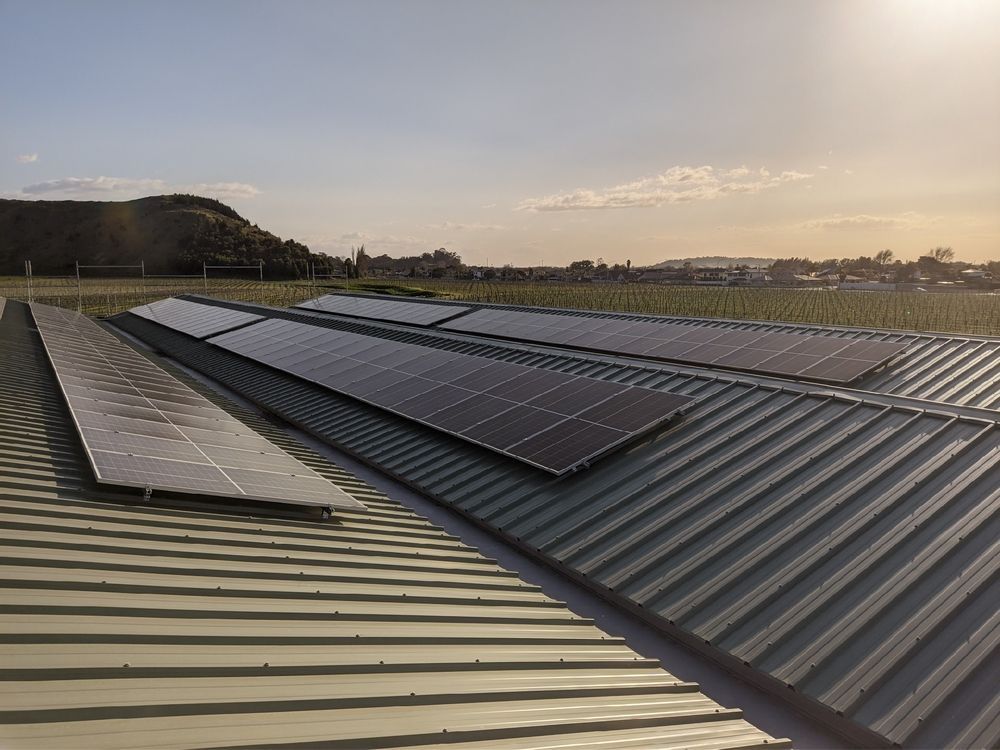
Mission Estate Winery Goes Solar
New Zealand’s oldest winery, Mission Estate Winery, has partnered with Freenergy Solar Solutions and Ecotricity NZ to install solar panels that will cover up to 35% of its annual electricity needs. By aligning solar output with peak demand, and combining this with past efficiency upgrades, the winery has already cut around five tonnes of CO₂ in its first few months of operation. It continues to top up its remaining electricity with climate positive power through an Ecotricity plan.

Contact us
Call us on free on:
0800 845 000To get pricing options and discuss your solar project goals contact:
[email protected]Learn more

Find a trusted installer
INSTALLER MAP
How the savings work with solar power
READ ARTICLE
Calculating your solar ROI
READ MOREFAQ's
Got a sunny question?
When you install solar panels, you're generating electricity that you would otherwise have to buy from the grid. That reduces your electricity import from the grid, so your bills go down. There's an upfront cost: solar systems in NZ generally cost NZ$10,000–$30,000 depending on size, usage, type, etc. Adding a battery increases cost but gives benefits (e.g. storing excess solar to use in evening or during outages). Over time, that upfront cost is “paid back” by reduced bills plus credits you get for any solar you export (i.e. don’t use yourself) to the grid. We estimate a payback period of around 7–9 years for many systems.
Also the savings are seasonal: more solar generation (hence more benefit) in summer, less in winter.
If your solar panels generate more electricity than you consume at any time, that excess electricity is exported to the grid. Ecotricity gives you credits for each unit (kWh) exported, which offset your electricity bills.
You need to have an import/export meter installed at your site. This is needed to measure both how much electricity you import from the grid and how much you export. Ecotricity arranges for this via your solar installer. Once you have that, your retailer (Ecotricity in this case) credits you for exported electricity under a buy-back/export tariff.
Smart meters report consumption (and import/export) data in half-hour intervals and then transmit this data daily to the metering company, which then passes it to Ecotricity. The data might take a few days to fully sync.
If there’s lag in data upload (communication delays), or if your solar app shows data from your inverter rather than the meter (inverter shows what panels are producing in real-time, but that might differ from what the meter records/export/import), differences can appear.
Also depending on which period your bill covers (meter readings) vs what period your app is showing (often real-time or recent), they may not align exactly.
You’ll see charges for:
-Imported electricity (the power you draw from the grid when your solar isn’t producing enough).
-Fixed daily or connection charges / network/lines charges and other variable charges like meter charges, GST etc.
-If you have solar and are exporting, you’ll also see credits for exported energy. Those will offset (reduce) your total bill.
If you are on a time-of-use plan (which many solar customers are), there will be different rates depending on when you use or export electricity. Peak vs off-peak periods. Ecotricity’s ecoSOLAR plan uses this scheme.
Check out our video on "How to read your power bill".